

Jakarta, 22 May 2025 – In April 2025, the United States officially implemented a reciprocal tariff policy on imported goods from countries with significant trade deficits with the U.S. This policy has created uncertainty in global markets, particularly for governments and related industry players. As a result, the International Monetary Fund (IMF) revised its global economic growth projection for this year down to just 2.8%. The decline was primarily driven by revisions in Gross Domestic Product (GDP) projections across nearly all countries.
Indonesia is among the countries affected by the U.S. reciprocal tariff policy, with a 32 percent tariff imposed on Indonesian export products, which was later put on hold by the U.S. Government for 90 days on April 9, 2025 to provide more time for negotiation. As of today, both the Indonesian and U.S. Governments are in a negotiation process, which is targeted to find the middle ground before the 90-days postponement ends. In line with the downward trend in global economic growth projections, the International Monetary Fund (IMF) forecasts Indonesia’s economic growth to reach 4.7% in 2025 and 2026 — a decline from the initial projection of 5.1% announced in January 2025.
SCG, one of the leading regional industrial players, has assessed that this situation will have both direct and indirect impacts. This is due to SCG’s operations across several countries affected by the U.S. tariff policy, including Thailand, Cambodia, Myanmar, Vietnam, and Indonesia.
US Policies Impacts towards SCG
The company projects that the direct impact will remain minimal, as exports to the U.S. accounted for only 1% of its total sales in 2024. On the other hand, indirect impacts are expected to emerge once the U.S. government’s 90-day postponement of reciprocal tariffs for several countries comes to an end. After the evaluation period, affected countries, including Indonesia, will be subject to varying tariff rates. Currently, the Indonesian and U.S. governments are engaged in negotiations, aiming to reach a mutual agreement before the postponement period concludes .
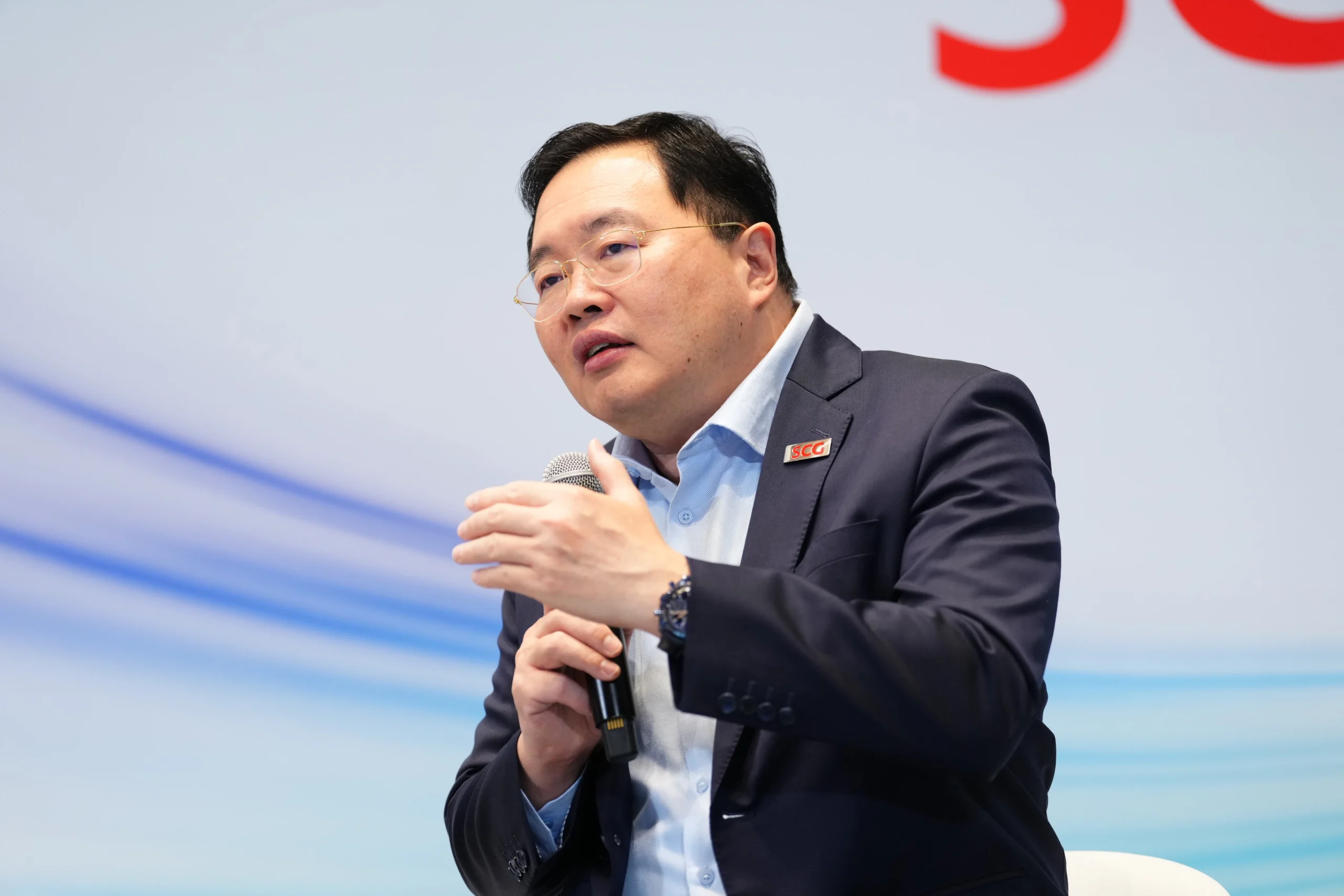
Thammasak Sethaudom, President and CEO of SCG, stated, “The trade war is exerting pressure globally, but opportunities still exist amidst these challenges. Examples include the downward trend in global oil prices, as well as continued strong purchasing power in certain markets for High Value-Added (HVA) products, environmentally friendly products, and quality products at affordable prices.”
SCG’s 4 Strategies to Face the Global Trade War
To address the unstable market conditions, SCG is deploying strategies to tackle the global trade war.
- Reducing costs to compete with global manufacturers in response to competition from low-cost products imported from other countries. Some of the approaches taken include:
- Reducing operational costs by consolidating production lines, improving efficiency, and streamlining processes, while increasing the use of robotic automation. In one of its subsidiaries, PT Semen Jawa, SCG uses Digital Mapping, mining land measurement technology that allows faster data processing, reducing human exposure to risks, and shortening the required travel time.
- Reducing administrative costs by leveraging Artificial Intelligence (AI) to enhance organizational efficiency. One of the AI technologies SCG applied is SA-RA, an AI-powered tool that helps to capture key discussions during online conversation.
- Optimizing working capital across the entire supply chain. SCG Barito Logistics implements a logistics backhaul matching system, aligning return shipments (backhauls) with available land transport on the same route to reduce empty-load trips and maximize delivery efficiency.
- Increasing the use of clean energy. Through its subsidiaries, PT Semen Jawa and PT Tambang Semen Sukabumi, SCG utilizes AF/AR (Alternative Fuel/Alternative Resources) technology, an advanced comprehensive waste-to-value system to replace costly energy sources such as coal and to reduce reliance on natural resources.
- Expanding the product portfolio to meet demand across all market segments by developing products to satisfy market needs in the HVA Products & Green Products, as well as Quality Affordable Products (QAP) categories.
- Entering new high-potential markets by expanding exports of products such as SCG Low Carbon Cement to new markets demonstrating strong demand.
- Building competitive advantages by leveraging diversified production bases across ASEAN, including strategically shifting production and exports to countries facing lower U.S. import tariffs. For example, SCGP’s packaging products can be manufactured and exported from Thailand, Vietnam, Indonesia, and the Philippines.
As a company committed to ESG principles, SCG believes that all industry players, including small and medium enterprises (SMEs), can play an active role in addressing the impacts of the ongoing trade war. SCG also recognizes that SMEs are the backbone of the national economy and are significantly affected by the current global trade war situation.
Warit Jintanawan, Country Director of SCG Indonesia, stated, “SCG is ready and open to collaborate with all sectors to share knowledge, enhance capabilities, and help businesses adapt and compete effectively. Through the GESARI (Gerakan Desa Berdikari) program, which has supported more than 70 SMEs in Indonesia, we are committed to expanding our reach to support small and medium enterprises in surviving amidst market instability while contributing to strengthening Indonesia’s national economy.”
***
Tentang SCG
SCG merupakan pemimpin bisnis regional dengan lini bisnis utama; Cement & Green Solutions, Smart Living, Decor, Distribution & Retail, Packaging, Chemicals, Cleanergy (Clean Energy), Logistics, Deep Technology & Digital, dan Investment. SCG berupaya menjawab kebutuhan yang beragam dari pelanggan melalui kemitraan kolaboratif dan pengembangan produk, layanan, dan solusi yang inovatif.
SCG memulai operasi bisnis di Indonesia sejak 1992 dengan membuka perdagangan dan secara bertahap mengembangkan investasinya dalam bisnis yang berbeda pada industri semen, bahan bangunan, bahan kimia, dan kemasan. Hingga hari ini, SCG memiliki total 38 perusahaan di seluruh Indonesia dengan lebih dari 8.000 karyawan.
Untuk informasi lebih lanjut, hubungi:
Amanda Utari
Brand and Communications Manager – PT SCG Indonesia
Phone: +6281110689798, Email: amandadwi@scg.com